The Avataram of Sri Balambika

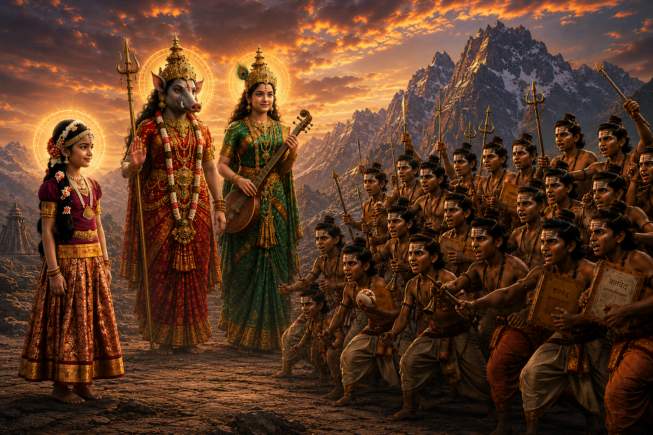
Sri Balambika or Balambiga is a child Goddess, She is a manifestation of Goddess Lalithambiga, She is described in the text Brahmanda Purana. During the war with Bhandasura there came a situation where the battle has to happen between the 30 Sons of Bhandasura, Since they were all children, Lalithambiga Manifested herself as a child Goddess of 9 year old to battle with the Sons of Bhandasura. Goddess Balambika is a extremely beautiful 9 year old girl with the unmatched qualities of her mother Sri Lalithambika. Her Smile made Sri Lalithambiga filled with joy and hugged her and she sat on the lap of her mother Sri Lalithambiga. Sri Balambika along with the great Goddesses Sri Varahi and Sri Shymala devi fought the battle. Sri Balambiga fought with the 30 Sons of Bhandasura and killed all of them in a fierce battle. She victoriously returned and sat on her mothers lap with all the Devi’s of Sri Lalithambiga army and all the God’s praising her.  The following stanza’s 26 – 30 from Lalitha sahasranamam is about Sri Balambika and her greatness.  In many Sri Vidya traditions, Sri Balambika is considered a gentle and compassionate first step into Sri Vidya upasana. She is also described as the Daughter of Sri Lalithambiga and Kameshwara.


Sri Lalitha Sahasranamam

चक्रराज-रथारूढ-सर्वायुध-परिष्कृता ।
गेयचक्र-रथारूढ-मन्त्रिणी-परिसेविता ॥ २६ ॥

cakrarāja-rathārūḍha-sarvāyudha-pariṣkṛtā .
geyacakra-rathārūḍha-mantriṇī-parisevitā .. 26 ..

She rides the royal chariot called Chakra Raja, and is equipped with all divine weapons. She is attended by her minister, Mantrini Devi, who rides the Geya Chakra chariot.

किरिचक्र-रथारूढ-दण्डनाथा-पुरस्कृता ।

ज्वाला-मालिनिकाक्षिप्त-वह्निप्राकार-मध्यगा ॥ २७ ॥

kiricakra-rathārūḍha-daṇḍanāthā-puraskṛtā .
jvālā-mālinikākṣipta-vahniprākāra-madhyagā .. 27 ..

She is accompanied by Dandanath Devi, who rides the Kiri Chakra chariot and leads the forces of discipline and command. She resides within a fortified palace surrounded by blazing walls of fire, created by the fiery goddess Jwalamalini.


भण्डसैन्य-वधोद्युक्त-शक्ति-विक्रम-हर्षिता ।
नित्या-पराक्रमाटोप-निरीक्षण-समुत्सुका ॥ २८ ॥
bhaṇḍasainya-vadhodyukta-śakti-vikrama-harṣitā
.
nityā-parākramāṭopa-nirīkṣaṇa-samutsukā .. 28 ..

She is delighted by the valor of her divine Shaktis as they prepare to destroy the army of Bhaṇḍāsur. She watches the bold and glorious might of the Nitya goddesses with joyful eagerness.


भण्डपुत्र-वधोद्युक्त-बाला-विक्रम-नन्दिता ।
मन्त्रिण्यम्बा-विरचित-विषङ्ग-वध-तोषिता ॥ २९ ॥
bhaṇḍaputra-vadhodyukta-bālā-vikrama-nanditā .
mantriṇyambā-viracita-viṣaṅga-vadha-toṣitā .. 29 ..

She rejoices in the heroic energy of Bālā Devi as she sets out to destroy Bhaṇḍāsur’s sons. She is pleased by the slaying of Viṣaṅg, carried out by her minister Mantriṇī Devi.


विशुक्र-प्राणहरण-वाराही-वीर्य-नन्दिता ।

कामेश्वर-मुखालोक-कल्पित-श्रीगणेश्वरा ॥ ३० ॥

viśukra-prāṇaharaṇa-vārāhī-vīrya-nanditā .
kāmeśvara-mukhāloka-kalpita-śrīgaṇeśvarā .. 30 ..

She delights in the valiant act of Vārāhī Devi, who destroyed the life-force of Viśukra. From a mere glance at Kāmeśvar’s face, she manifested the divine form of Śhrī Gaṇeśha, the remover of obstacles.
Sri Balambika in Sri Vidya and the Sri Chakra
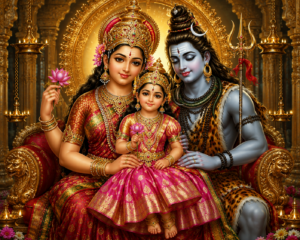
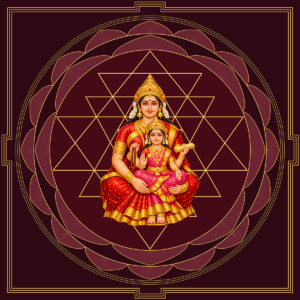
Sri Balambika, revered as Bālā Tripurasundarī, is the Divine Mother in the form of a young girl. The Lalitopākhyāna portrays her as Lalitā’s nine-year-old daughter, always near her mother. The Tripurārahasya invokes Bālā and Lalitā as names of the same Goddess. These two accounts help explain why Balambika holds a place in Sri Vidya, the tradition centred on the worship of Lalitā Tripurasundarī, and how her worship is related to the Sri Chakra. [1] [2]

Bālā beside Lalitā

In chapter 26 of the Lalitopākhyāna, Bālā asks her mother’s permission to face the thirty sons of Bhaṇḍāsura. Lalitā hesitates because of her daughter’s tender age. She calls Bālā her very life-breath and finally embraces her before giving her armour and weapons. As Bālā descends from Lalitā’s Cakrarāja chariot, the deities stationed on its tiers bow with folded hands. Elsewhere the text describes the chariot as having nine tiers and names the groups of Śaktis stationed on them. Many of those groups also appear in the nine enclosures of the Sri Chakra, giving the chariot episode its connection to the sacred diagram. [1] [3]

The Lalitā Sahasranāma remembers this episode in verse 29, praising Lalitā as the one who rejoices in Bālā’s valour. Later, in verse 177, the hymn includes Bālā among Lalitā’s own names. The Tripurārahasya brings those names together in the account of Paraśurāma initiating Sumedha. Before imparting the mantra, he offers flowers to the Goddess seated on a golden throne and invokes her as Bālā, Tripurā, Lalitā and Śrīkumārikā. [2] [4]

The Sri Chakra and its centre

The Sri Chakra is a yantra, a sacred diagram in which Lalitā is worshipped. Its nine āvaraṇas, or enclosures, extend from the outer square to the bindu, the central point. The Yoginīhṛdaya names Mahātripurasundarī as the Goddess of the ninth and innermost enclosure, Sarvānandamaya, the realm of all bliss. In verse 182 of the Lalitā Sahasranāma, Lalitā is called Śrīcakrarājanilayā, she who dwells in the sovereign Sri Chakra. [4] [5]

Bālā also has a place in the ritual itself. The Paraśurāma Kalpasūtra uses the Bālā mantra in the Śrīkrama, the sequence of Lalitā’s worship, when establishing the ritual seat of the Sri Chakra. Bālā is also worshipped in her own right. A study of living traditions in Kerala documents initiation into her mantra and the use of a Bālā yantra in that worship. [6] [7]

The bindu in Balambika’s own worship

The Śrī Bālā Saparyā Pūjā describes Balambika through names that recall the centre of the Sri Chakra. It calls her Sarvānandamayādhipā, sovereign of the realm of all bliss, Bindusthalamanoharā, the enchanting one at the bindu, and Trikoṇamadhyanilayā, she who dwells in the middle of the triangle. The next verse pictures Bālā seated on the lap of Kāmeśvarī, who herself sits on the lap of Śiva Kāmeśvara. The manual also describes a diagram for Bālā’s worship that includes a central point, a triangle and a six-pointed figure. The classical Sri Chakra’s ritual map names Lalitā Mahātripurasundarī at its bindu, while Bālā’s own worship gives the child Goddess these titles and its own sacred geometry. [5] [8]

This connection is also visible in Tamil Nadu. The Sri Bala Tripurasundari Temple at Sattamangalam, near Maraimalai Nagar, lists Bālā as its main deity and reports performing Navāvaraṇa Pūjā on full-moon days. Its Tamil Aṣṭottara, the litany of 108 names, preserves the names that praise her at the bindu and in the central triangle. [9]

One phrase from the Śrī Bālā Saparyā Pūjā brings these accounts together. It asks the devotee to contemplate Parāmbā Bālarūpiṇī, the Supreme Mother in the form of a child. The Goddess whom the Sri Chakra honours as Lalitā Mahātripurasundarī is the same Mother whom devotees approach with affection as Sri Balambika. [2] [5] [8]

Sources

  1. Brahmāṇḍa Purāṇa, Lalitopākhyāna, chapter 26, vv. 72–89 and 110–117, translated by G. V. Tagare. English translation.
  2. Tripurārahasya, Māhātmya-khaṇḍa 1.42c–44. Sanskrit and English translation in Silvia Schwarz Linder’s Oxford Centre for Hindu Studies handout. See also her Goddess Traditions in India (Routledge, 2022), p. 18.
  3. Lalitopākhyāna, chapter 19, the deities on the chariot, and chapter 29, vv. 35–38, the nine tiers. Compare the enclosure lists in the Śrī Devī Khaḍgamālā Stotra.
  4. Lalitā Sahasranāma, vv. 29, 177 and 182. Sanskrit text.
  5. Yoginīhṛdaya 2.8–12, in André Padoux and Roger-Orphé Jeanty, The Heart of the Yogini (Oxford University Press, 2013), p. 61. Chapter reference.
  6. Paraśurāma Kalpasūtra, Śrīkrama 3.1 and 3.18–19. Sanskrit text and transliteration.
  7. Maciej Karasinski-Sroka and G. Sudev Krishna Sharman, “The Young Goddess Who Dances through the Ordinariness of Life—A Study on the Tantric Traditions of Kerala,” Religions 13, no. 7 (2022), article 667. Open-access study.
  8. Śrī Bālā Saparyā Pūjā, invocation verses and Nāmasmaraṇapūrvakasvarūpadhyāna, vv. 16–18 and 22. Sanskrit text.
  9. Sri Bala Tripurasundari Temple, Sattamangalam. Temple history, worship schedule and Tamil Aṣṭottara.

Nemili Bala - The Grace of Sri Balambika

Sri Bala Peetam at Nemili is not a conventional temple. It is a humble house where, according to tradition, Sri Bala Herself chose to reside. This gives the place a unique sacredness — simple in appearance, but deeply powerful in experience.

Nemili is located near several sacred and historic towns: about 55 km from Vellore, 24 km from Kanchipuram, 16 km from Arakkonam, 30 km from Sholingur, and 20 km from Kaveripakkam.

According to the traditional account, about a hundred years ago, Sri Bala appeared in the dream of Shri Subramania Iyer and instructed him to bring Her from the Kushasthalai river. For several days, he searched near his home and along the river banks. Finally, he discovered a small bronze idol of the Goddess in the river.

With great devotion, Shri Subramania Iyer consecrated the idol and placed Her in the center of his house. Over time, this sacred home became known as Sri Bala Peetam.

The presiding deity of the Peetam is Sri Raja Rajeswari, the family deity worshipped by the priests there. Sri Bala Tripurasundari is revered as the child form of the Divine Mother, who has manifested on earth to bless Her devotees.

A special aspect of Nemili Sri Bala worship is the emphasis on pure devotion. Devotees are encouraged to pray with sincerity, without bargaining with the Goddess or making transactional promises in return for fulfilled wishes. It is believed that Sri Bala does not favor a bargaining attitude; She responds to love, surrender, and simple-hearted prayer.

Sri Kanchi Paramacharya is said to have performed pooja at this sacred place in 1945 along with his religious group for three full days, adding to the spiritual significance of the Peetam.

The great spiritual speaker Thirumuruga Kripananda Variyar is also associated with praise for this Peetam. He is remembered for expressing that in this great Peetam, one can experience the presence of many divine forms.

Nemili Sri Bala continues to draw devotees through Her child-like grace, Her divine simplicity, and Her powerful blessings. For many, She is not merely a deity to be worshipped, but a living Mother who listens, protects, and guides.

Nemili Sri Bala is worshipped by devotees as a small and tender child Goddess, yet Her grace is experienced as radiant and powerful like the Sun. Though the idol is very small, devotees believe that Her presence is immense, compassionate, and spiritually powerful.